

Wandercraft Launches Eve™, the World’s First Self-Balancing Personal Exoskeleton, Bringing Hands-Free Upright Mobility to the Home
FDA-cleared Eve is now commercially available in the U.S. to eligible adults with spinal cord injuries at any level, supported by a growing network for evaluation, training, reimbursement, delivery, and service
NEW YORK, Sept. 17, 2026 (GLOBE NEWSWIRE) -- Wandercraft today announced the U.S. commercial launch of Eve™, the world’s first FDA-cleared self-balancing personal exoskeleton, which makes hands-free upright mobility available to eligible wheelchair users living with spinal cord injuries at any level, who can manually operate the device’s controller.
Eligible individuals can now begin the process of obtaining Eve, starting with a clinical evaluation and trial. After a successful trial and a physician's order, Eve is individually fitted and manufactured. Each user then completes a personalized training program with the Wandercraft team before delivery, with ongoing support afterward.
Unlike exoskeletons that require crutches or a walker for balance, Eve uses self-balancing technology powered by physical AI, allowing users to stand and move upright while keeping their hands free to reach, carry objects, prepare food, open doors, and participate in other activities of daily living. Eve is designed to complement, not replace, a wheelchair, offering another mobility option for moments when users choose to be upright.
Watch Eve in action in this video.
Eve is the first FDA-cleared device in this category without restrictions based on the neurological level of spinal cord injury. Instead, eligibility extends to adults with spinal cord injuries at any level who can safely operate the controller and have no contraindications listed in the User Manual. This significantly expands the potential user population compared with previously cleared exoskeletons and reflects the breadth of the safety data, clinical evidence, and usability testing Wandercraft developed to support its FDA submission.
“FDA clearance showed that Eve was ready to move forward. Today is about making it a reality for the people we built it for,” said Matthieu Masselin, co-founder and CEO of Wandercraft. “We have spent years developing the robotics, but our breakthroughs only matter when we’re able to better connect people to the world around them. That’s why we built an infrastructure that supports people every step of the way, from evaluation and fitting to reimbursement, training, and ongoing service.”
“With Eve, being upright isn’t just about standing. It’s about having the freedom to use my hands, move through my home, and connect with people in a new way,” said Caroline Laubach, a Wandercraft test pilot. “Those everyday moments bring me so much joy. What makes this milestone especially meaningful is knowing that more people will now have the chance to experience Eve for themselves and find that same joy in their own way.”
Eve at a Glance
- Commercially available in the U.S. today. Eve is the first FDA-cleared personal exoskeleton without restrictions based on the neurological level of spinal cord injury, expanding eligibility to a broader user population. Users complete a clinical evaluation and training program with a companion before taking Eve home.
- Self-balancing and hands-free. Eve maintains its balance without crutches or a walker, leaving users’ hands free for everyday activities.
- Individually prescribed and fitted. After receiving a prescription from a provider, Eve is custom-fit and manufactured for each individual user.
- Available to experience now at Walk in New York by Wandercraft, with Walk in Miami by Wandercraft opening in November and additional partner centers through our partner, National Seating & Mobility (NSM).
-
Reimbursement pathways are in place. Personal exoskeletons are covered by Medicare, the Department of Veterans Affairs (via USVetServ), and workers’ compensation programs, subject to applicable requirements. Financing options are available to individuals who choose to self-pay. Wandercraft's dedicated Access team is working with payers nationwide to expand coverage pathways, including an ongoing focus on private insurance plans.
Trial, Access, and Reimbursement
Wandercraft’s dedicated access team helps users and their care teams navigate benefits, documentation, reimbursement, financing, and coordination with clinicians and payers. For individuals who meet eligibility and medical necessity requirements, Medicare covers qualifying personal exoskeletons as custom-fitted orthoses under HCPCS billing code K1007, subject to individual coverage requirements.
National Seating & Mobility (NSM), Wandercraft’s exclusive Complex Rehabilitation Technology (CRT) distribution partner for Eve, will support evaluation, education, access, and delivery through a network of more than 180 locations. CRT providers connect users with clinicians, Assistive Technology Professionals, payers, and other specialists involved in complex mobility care, providing the individualized support needed to move a sophisticated mobility device from prescription to personal use.
Good Shepherd Rehabilitation will complement the national network by expanding access to Eve in Pennsylvania’s Lehigh Valley. As a Wandercraft Center of Excellence, Good Shepherd has developed deep expertise in supporting patients throughout their care journey with Atalante X and will now serve as Wandercraft’s exclusive Eve partner in the region. Eligible users and their companions can learn about Eve and, eventually, experience the technology at the Hyland Center. Additional access locations are expected to open in the future.
USVetServ, a Service-Disabled Veteran-Owned Small Business, will serve as an authorized independent distributor of Eve and Atalante X for the U.S. Department of Veterans Affairs, its medical centers, and other VA facilities nationwide.
New Research Supports the Transition to Personal Use
Eve’s commercial launch follows the publication of new peer-reviewed research examining how people with tetraplegia and high paraplegia, along with their companions, can be trained to use a self-balancing exoskeleton for personal use.
The study, published in the Journal of Visualized Experiments (JoVE), reports findings from research conducted at Kessler Foundation and the James J. Peters VA Medical Center. Among the first 16 participants who completed the protocol, all achieved the study’s performance goals for the Timed Up and Go and the 6-Minute Walk Test; 15 achieved the donning goal after four training sessions, and all achieved the doffing goal. The researchers reported no serious adverse events among the participants who completed the protocol.
Separately, research presented Sept. 8 at the Academy of Spinal Cord Injury Professionals (ASCIP) Annual Meeting in Salt Lake City reported findings from the first 16 participant pairs who completed Wandercraft’s pivotal study at James J. Peters VA Medical Center and Kessler Foundation. Results showed that Eve supported safe, hands-free assisted walking for people with spinal cord injury, with a low adverse-event rate. Participants also performed key mobility tasks and activities of daily living with high perceived safety, user satisfaction, and ease of training.
“What is important about this work is that we evaluated more than whether someone could stand or walk in an exoskeleton,” said Gail Forrest, PhD, director of the Tim and Caroline Reynolds Center for Spinal Stimulation at Kessler Foundation. “We examined whether people with high-level spinal cord injuries and their companions could learn to use a self-balancing exoskeleton and perform functional tasks relevant to personal use. Commercial availability is an important next step toward translating that clinical work into carefully supported use in everyday life.”
Celebrating the Launch in New York
Wandercraft will mark Eve’s commercial launch this evening at Cure, 345 Park Avenue South in New York City, during an event presented with United Spinal Association as it celebrates its 80th anniversary. The event will feature live Eve demonstrations and bring together people living with spinal cord injuries, clinicians, researchers, disability advocates, policymakers, Eve pilots and their families, and Wandercraft leaders.
The program will be livestreamed starting at 6:00 p.m. ET and is free to watch. Register for the Sept. 17 livestream:
https://share.hsforms.com/2iWRkru7sTcmpTGdO6_Lo1Q5aapy
To learn more about Eve or request an evaluation, go to: https://www.wandercraft.eu/form.
About Wandercraft
Wandercraft is a global robotics company with a proprietary physical AI platform spanning medical and industrial applications. Eve™, its FDA-cleared personal exoskeleton, supports hands-free upright mobility for personal use, while Atalante X™ is used in more than 150 rehabilitation and research centers worldwide. Wandercraft also applies its robotics expertise to industrial humanoid systems, including Calvin-40™, an autonomous humanoid designed for physically demanding and difficult-to-staff work. Learn more at Wandercraft.eu.
Contact
Sarah Jallot
Global Growth at Wandercraft
Sarah.Jallot@wandercraft.health
Photos accompanying this announcement are available at:
https://www.globenewswire.com/NewsRoom/AttachmentNg/ef8f714b-c748-4175-8083-132afbc6a0d1 https://www.globenewswire.com/NewsRoom/AttachmentNg/8161abe0-1b25-455e-b9df-bb08747be4cd
https://www.globenewswire.com/NewsRoom/AttachmentNg/4c4df7c0-a34d-45c3-ac57-333003edb132
A video accompanying this announcement is available at:https://www.globenewswire.com/NewsRoom/AttachmentNg/34fa9d21-8f14-432a-9bc4-5b0aeb613fd2


Eve™, Wandercraft’s FDA-cleared self-balancing personal exoskeleton
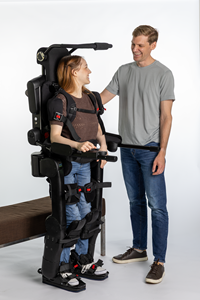
Eve™, the world’s first FDA-cleared self-balancing personal exoskeleton, makes hands-free upright mobility available to eligible wheelchair users living with spinal cord injuries at any level, who can manually operate the device’s controller.
Eve™, Wandercraft’s FDA-cleared self-balancing personal exoskeleton
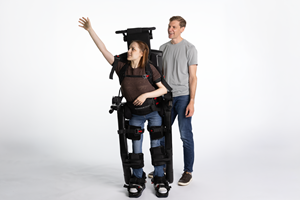
Eve™, Wandercraft’s FDA-cleared self-balancing personal exoskeleton, is designed to support hands-free standing and movement for eligible adults living with spinal cord injuries.
Wandercraft’s FDA-cleared Eve™ self-balancing personal exoskeleton supports hands-free upright movement during everyday activities.
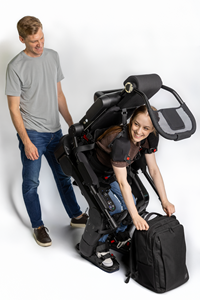
Wandercraft’s FDA-cleared Eve™ self-balancing personal exoskeleton supports hands-free upright movement during everyday activities.
Legal Disclaimer:
EIN Presswire provides this news content "as is" without warranty of any kind. We do not accept any responsibility or liability for the accuracy, content, images, videos, licenses, completeness, legality, or reliability of the information contained in this article. If you have any complaints or copyright issues related to this article, kindly contact the author above.
